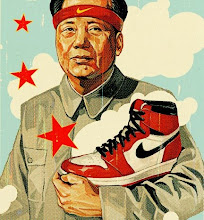
Woah. Look! Blogspot is back up in China. That's weird. How many months was that??
One of the reasons I wasn't posting was because it was blocked. I guess that excuse is out.
Tuesday, June 10, 2008


Tuesday, June 03, 2008
Shenzhen Increases Minimum Wage
Shenzhen has announced that its minimum salary level will go up on July 1, 2008. This makes the minimum wage higher than that of Shanghai and Guangzhou.
In reality, the minimum wage doesn't effect the vast majority of Shenzhen workers. Even the factory worker on the bottom of the pyramid makes atleast 1600 to 1800RMB per month. If anything it helps the workers of McDonald's and KFC.Under the adjustment plan, four districts within the Special Economic Zone including Futian and Luohu districts will see their minimum wage level reach one-thousand yuan per month, up over 17 percent from previous year.
Elsewhere, the minimum wage will rise 20 percent year on year to 900 yuan a month. The local government says the move aims to enhance the city's competitive power and to attract more talent. Shenzhen now has more than 7 million migrant workers, but it is still short of over 740 thousand laborers. Increasing salary may help labor-thirsty companies to employ more staff.
Thursday, May 29, 2008
Plastic Bags no More
Starting on June 1, 2008 (in 3 days), Shenzhen retailers will stop offering free plastic bags. As an effort to help the environment and reduce the reliance on plastic bags, Shenzhen - as well as other Chinese cities - are beginning to implement this new regulation.
As Shenzhen Daily states:
Retailers will be fined up to 10,000 yuan (US$1,429) for providing free plastic bags or selling plastic bags to customers at lower than cost from June 1, the city's pricing watchdog said Friday. The ban has been instituted under a regulation drawn up by the Commerce Ministry to save energy and reduce white pollution.
Stores like Walmart, ABest and Carrefore have all promoted the use of clothbags. They have done promotions and free giveaways as well. Use of plastic bags will cost 0.50 to 1RMB.
As Shenzhen Daily states:
Retailers will be fined up to 10,000 yuan (US$1,429) for providing free plastic bags or selling plastic bags to customers at lower than cost from June 1, the city's pricing watchdog said Friday. The ban has been instituted under a regulation drawn up by the Commerce Ministry to save energy and reduce white pollution.
Stores like Walmart, ABest and Carrefore have all promoted the use of clothbags. They have done promotions and free giveaways as well. Use of plastic bags will cost 0.50 to 1RMB.
Monday, May 26, 2008
Shenzhen Democracy
For the past 30 years, Shenzhen has been the big Chinese experiment on capitalism. This Special Economic Zone started from a fishing village to become the most modern Chinese city. Not only is the economy in the forfront, but the rule of law, transportation and civil systems are among the best in China. There has even been talk about a Shenzhen - Hong Kong mega city in its future plans while the development of Shenzhen's airport has been mentioned in Kanye West's blog.
This big experiment seems to be ready to expand to politics as well. Reported in the Pakistan Observer, Shenzhen's steps Toward Democracy describes the future development of an“intraparty democracy.”
I have been recently been considering leaving Shenzhen, but I might just have to stay a little bit longer to see these things happen firsthand, undercover.
This big experiment seems to be ready to expand to politics as well. Reported in the Pakistan Observer, Shenzhen's steps Toward Democracy describes the future development of an“intraparty democracy.”
The Shenzhen local government published a draft of a document titled “Shenzhen Future Reforms” on its Web site for the public to comment upon . The draft summarizes tentative plans for political, administrative, economic and cultural reforms in Shenzhen and describes 19 key tasks, including the holding of mayoral elections in Shenzhen when “conditions allow.” Members of the regional National People’s Congress will be allowed to run directly in these elections.
By conducting China’s “intraparty democracy” experiment in Shenzhen, Chinese President Hu Jintao is paying homage to the legacy of Deng Xiaoping and signaling that if the test proves successful, intraparty democracy will spread to the rest of China.
The document is a result of the National People’s Congress in March, when “intraparty democracy” the Chinese Communist Party (CPC) version of “rule by consensus” was put in place as one of the key planks of Chinese President Hu Jintao”s legacy. The groundwork for the Shenzhen experiment originally was laid in March when Wang Yang, secretary of the CPC’s Guangdong Provincial Committee, visited Shenzhen and officially announced that the city would “set an example for the nation.” Such initiatives have been tried at the village level before but never in as large or as prominent a city as Shenzhen.
Long a showcase for new ideas from the center, Shenzhen was one of the original sites of Chinese leader Deng Xiaoping’s groundbreaking economic, political and social reform programs and was home to China’s first special economic zone. By formally launching China’s intraparty democracy experiment in Shenzhen, Hu is paying direct homage to Deng’s legacy and signaling that if this test proves successful, intraparty democracy will spread to the rest of China. The province of Guangdong has never built the political power base that Shanghai has, so this latest spotlight on Shenzhen does not signal an impending central government “crackdown” on disobedient local officials.
Beijing wants to build some sense of accountability in the prevailing system and emphasize that the party and government are owned by the people.
I have been recently been considering leaving Shenzhen, but I might just have to stay a little bit longer to see these things happen firsthand, undercover.
Wednesday, May 21, 2008
China's New Path
As a resident of Shenzhen, I've been able to see both the best and the worst of China - relative to change.
As many people already know, Shenzhen is a wonder of capitalism in China. It has grown out of nowhere in the past 20 years. It is the most modern Chinese city. It is a place with limitless opportunities and possibilities. It is a place where all of the able people from all over China and the world come to gather for commerce. It is a place of law and order - the best in China.
Shenzhen is also a lot of other things. It is one of the only places that has absolutely no culture within a country and civilization that has lasted more than 5000 years. It is a cut-throat world where money is first and foremost. Everything else is secondary. It is a place of questionable morals and the air quality is just as bad.
Shenzhen was famously created by Deng Xiaoping who famously announced that "to be rich is glorious." Ever since those famous words were uttered, China has transformed from a place focused on equality to that of money. It was a place where personal possessions and wealth were not the focus, but community was overriding. People helping people even though everyone had very little. It has emerged to a place where money and materialism is paramount while the community is just an afterthought. Now the discrepancy between the haves and have-nots is incredible.
In the past few years, this path of money has never been questioned on the grand scale. Although certain events have brought the Chinese people together (the spy plane incident, the japanese textbooks, the Olympics), everything was still on the same trajectory.
That was until 5/12/2008 at 2:28pm.
In the past few days - and during the mourning period - the only thing on TV has been coverage of the earthquake. Every single channel. All Bars have been closed. All KTVs have been closed. Even online games have been abandoned. It is a national mourning in every respect. During this time, people from every walk of life, from every region and province have come together to do what they can in support of the recovery efforts. If you can donate money, ok. Time and effort, good as well.
Candlelit visuals have been everywhere. The only real topic of conversation is the earthquake. Everything else is secondary. It is something that I've never seen, but so immensely proud of from my fellow countrymen.
During the events of 9/11, I was in my high school in New Jersey. In the past 7 years, those events have completely and utterly transformed American society. Whether it is political, environmental or social, so many things have been altered.
I predict that the earthquake of 5/12/2008 will have a comparable effect on China. Not only will government initiatives change, but the people will too. The people have been reminded of what it once was, a place where people cared about its fellow people. It has woken up from a period of rapid growth into something thats more wholly rounded and responsible for all in society. Not only will there be much more social activism but the compassion and empathy of the people will increase.
This is now the path of China. Not a path towards "democracy" (as the western media states) but towards a embrace for the communal-ness of its past.
As many people already know, Shenzhen is a wonder of capitalism in China. It has grown out of nowhere in the past 20 years. It is the most modern Chinese city. It is a place with limitless opportunities and possibilities. It is a place where all of the able people from all over China and the world come to gather for commerce. It is a place of law and order - the best in China.
Shenzhen is also a lot of other things. It is one of the only places that has absolutely no culture within a country and civilization that has lasted more than 5000 years. It is a cut-throat world where money is first and foremost. Everything else is secondary. It is a place of questionable morals and the air quality is just as bad.
Shenzhen was famously created by Deng Xiaoping who famously announced that "to be rich is glorious." Ever since those famous words were uttered, China has transformed from a place focused on equality to that of money. It was a place where personal possessions and wealth were not the focus, but community was overriding. People helping people even though everyone had very little. It has emerged to a place where money and materialism is paramount while the community is just an afterthought. Now the discrepancy between the haves and have-nots is incredible.
In the past few years, this path of money has never been questioned on the grand scale. Although certain events have brought the Chinese people together (the spy plane incident, the japanese textbooks, the Olympics), everything was still on the same trajectory.
That was until 5/12/2008 at 2:28pm.
In the past few days - and during the mourning period - the only thing on TV has been coverage of the earthquake. Every single channel. All Bars have been closed. All KTVs have been closed. Even online games have been abandoned. It is a national mourning in every respect. During this time, people from every walk of life, from every region and province have come together to do what they can in support of the recovery efforts. If you can donate money, ok. Time and effort, good as well.
Candlelit visuals have been everywhere. The only real topic of conversation is the earthquake. Everything else is secondary. It is something that I've never seen, but so immensely proud of from my fellow countrymen.
During the events of 9/11, I was in my high school in New Jersey. In the past 7 years, those events have completely and utterly transformed American society. Whether it is political, environmental or social, so many things have been altered.
I predict that the earthquake of 5/12/2008 will have a comparable effect on China. Not only will government initiatives change, but the people will too. The people have been reminded of what it once was, a place where people cared about its fellow people. It has woken up from a period of rapid growth into something thats more wholly rounded and responsible for all in society. Not only will there be much more social activism but the compassion and empathy of the people will increase.
This is now the path of China. Not a path towards "democracy" (as the western media states) but towards a embrace for the communal-ness of its past.
Subscribe to:
Posts (Atom)