Showing posts with label Culture/Society. Show all posts

Saturday, March 05, 2011

The UFC and the Future of the Mongolian Wolf

The UFC might have just found their Yao Ming.

Since entering the Chinese market in 2009 with its initial broadcasting deal, the UFC has found the Chinese market tricky but full of potential in its future plans.

About a week ago when looking through my google news feed, I saw that a Chinese guy had just won a quick victory in the UFC. (video) Since then there has been an increasing amount of coverage in online and tv media on the "Mongolian Wolf," Tie Quan Zhang. The idea of a rugged Chinese guy beating up on the best fighters in the world really makes for good TV in China (just watch the movie 叶问2 that recently came out). He really might have the potential to be that spark that blows up the China market for the UFC.

Chinese people love their heroes and winners. In a country that only really cares about gold medals and being number 1 (theres even a mineral water brand thats the Chinese pronunciation of the English, "number one"), anyone who has the potential to be among the best in the world stage is quickly embraced and looked up to.

Yao Ming is famous by competing with Shaq in the NBA, Liu Xiang won the 1st gold medal for men in Olympic track & field, and Li-Ning built an entire global brand around his gymnastics exploits. Although Li Na and Zheng Jie are building the reputation for women's tennis, China really loves its male heroes. Thats the only explanation for the Chinese men's soccer team getting soo much funding.

This phenomenon this is a symptom of the Opium War/"century of shame" and Chinese male masculinity/identity issues. These issues influence society to the core - including current trends in growing male grooming products market. Chinese people believe that China has not re-assumed its rightful place in the world stage so any conquering hero that can assume this position (no matter how brief) is idolized. 

Not only can the Mongolian Wolf grow the UFC market access in China, his future potential for stardom and fame is greater than both Yao Ming and Liu Xiang. If he dominates in the ring in hand to hand combat, it will outshine winning any race or dunking on any player. Zhang Tie Quan is what the Chinese have been waiting for. And with a nick-name like Mongolian Wolf, how could he fail?

Tuesday, March 01, 2011

Soft Power and the Future of China's World PR

During the Hu Jintao summit in the US about a month ago, I was lucky enough to see firsthand the 60-second “Pro China” advertisement broadcasted both in NYC’s Times Square and the Chinatown area in Washington DC.


Promoted as a well-received commercial that better let Americans understand China by the Chinese media, this ad sparked a lot of debate in both countries. While it might have passed on positive feelings to some Americans, more than a few online commentators referred to it as China giving the US "the finger." While I agree that the ad might not had the effect intended by the Chinese gov't when it was originally designed, the actual act of making the ad forecasts a strong step forward in China's pursuit of soft power.

China has had a PR problem for some time now. I first noticed it in the Spring of 2009 on a week-long trip to Ghana. My mother was analyzing China's investment and influence in Africa with Ghana as a case study with a fellow professor who was from Ghana. I tagged along as it was a great opportunity to go better understand Africa.

During our visit to the Chinese consulate, we talked to 3 officers who discussed the threats and opportunities of Chinese companies in Ghana. While trading companies were booming in importing a lot of consumer goods from China to Ghana (much from Shenzhen), Chinese companies had made very little headway in the mining and coco industries. These were all dominated by European companies who had been here for a long time.


Most of Chinese business interaction in Ghana was in the form of loan-for-buildings. We visited sites all over Ghana that featured completed buildings and structures built by the Chinese. This included the national theater and the monument for the 1st Ghana president in Accra, a soccer stadium and a bridge near Tamale in the north.


We were also fortunate enough to visit a hydro-electric dam currently under construction a couple of hours outside of Kumasi - in the central part of Ghana.


In all of our visits and conversations with both local Ghanaians and Chinese workers and managers, there seemed like a communication disconnect between the two groups. Locals often complained about the bad practices of Chinese companies. The Chinese complained about the laziness of the locals and their not appreciating what the Chinese were doing for them.

As stated from the Chinese perspective, whenever there were any disagreements or individual problems with workers, those isolated people would immediately be given to the media and then pieced together to show how bad and manipulative the Chinese were. The people at the consulate felt that they were being portrayed unfairly and tried to do their best in better publicizing their investments and contributions to the local community in their newly established press office. Needless to say short articles stuck in the local news section of the newspaper didn't have much effect on the problem.

After my Ghana trip, I realized a few things:

  1. the PR industry in China will only grow in the future
  2. anytime a report on how bad Chinese investors are in Africa, S. America and other parts of the world shows up, it has a good likelihood of being created from the already established political discourse on China. (see this video from CNBC for more)
  3. any real progress in soft power will happen from efforts of individual companies and people - not from a coordinated central government agenda

The Chinese government has really tried make a coordinated effort to improve soft power in the world. Even before the NYC Times Square ad, China has tried to rebrand itself.  In the past few years, it has promoted Confucius Institutes in the world, established a CNN-style news network (creating it out of CCTV-9), created a Reuters/AP type organization within CCTV to sell comprehensive English reports to news outlets all over the world (my mom's college friend is a editor there), and even rolled out a Confucius statue in Tiananmen Square.

However, all of these government measures hasnt changed the fact that any mention of the Dali Lama will go directly to China's bad human right's record, and any event on Tiananmen Square will mention the riots of 1989. These government initiatives dont work as well as the indirect effects of individual companies. My friend in Beijing has tried to market Chinese indie films all around the world for the past few years. Her efforts to show a foreign audience an alternative side of China is an example of how small companies are contributing to Chinese soft power in various culture fields.

The best recent example of an ad that (I believe) is great is an Li-ning shoes commercial in the US. It came out around the same time as the NYC Times Square video, but definitely hits it out of the park in helping create a new understanding of China and Chinese people to the American audience. Only with commercials like these over a long period of time will any real soft power be created.


Sunday, December 26, 2010

Freeway Parking Lots in Beijing

If my memory serves me right, the traffic during the Beijing Olympics were awesome! Even though there was a dedicated lane for Olympic vehicles only on every street traffic was swift. Due to the implementation of the odd/even number system on alternate days, only half the allotted cars in Beijing were allowed on the road. That's the government taking charge at its best.

As the Olympics ended, local citizens discussed the necessity of policies such as the odd/even car plate system and others that helped combat pollution. Everyone agreed that it was preferable to keep the policies in place but not realistic.

Fast forward 27 months later and finally taking some kind of action to curb the congestion problems in Beijing. The government will begin to limit the amount of new vehicles coming onto the streets to only 240,000 next year. Although theres a rule that limits car use one day per week, the number of cars in Beijing has sky rocketed in the past 2 years. Reports claim that
...as of December 19, the capital had 4.76 million vehicles, 700,000 more than that at the beginning of 2010 and contrasting with 2.6 million in 2005.

What are you going to do about the almost 5 million cars already on the roads?? How can the average speed of cars on Beijing roads be only 13mpg? ONLY 13?

Traffic in Beijing is not like normal cities where there is a rush hour in the morning going to work and in the evening getting out of work. The only time where there is not rush hour is between 9pm and 6am. At all other times, there will be consistent bumper to bumper traffic where its impossible to go above 20mpg.

The traffic is so bad that its difficult to schedule any kind of business dinners or dining out with friends unless someone comes incredibly late. Combine this with subway cars absolutely packed during rush hour and theres no real way to get around the city. That's why I always stay around one specific area (East 3rd ring) and rarely venture out anywhere when I'm in Beijing.

Please, Beijing gov't, take charge and get all of these cars off the street. I don't understand how you put this problem off until now, but do something! I understand that China wants to develop the auto industry as a pillar industry in China. I also understand that people buying cars increase GDP, but shouldn't there be a consideration of the social good? What good are cars if they just sit on freeways that resemble more like parking lots??

Monday, February 09, 2009

Chinese Savings = Religion

For the past few weeks, I've been spending more time with my grandparents. They came to visit our extended family for Chinese New Year and are enjoying the warm weather and nice accommodations here in Shenzhen. I try to see them at least 3-4x a week and I usually take them out to eat western food - something they enjoy but don't frequently do. 

Even though each of my grandparents still receive more than 3000 per month in retirement from the government as well as consistent money from my mom and uncles, they always stash it away. (My grandparents also have all of their medical bills taken care of by the gov't.) I have been trying for some time now to convince them to spend more money to enjoy their golden years. What’s wrong with more traveling, taking taxis and eating well? They won’t do it, but are always saving. Although they like eating McDonald's and Pizza Hut, they don't like to pay for it.

While the western media argues that due to the lack of a social safety net and social security system, Chinese people absolutely need to save - because the gov't won’t take care of them. I disagree with this notion. 

Saving money is a religion in China, especially for older generations. While some people have plenty of money saved away already, they still do it. Their daily lives have been routine for so long that there’s hardly any time or anywhere to spend the money. Buying groceries in the morning, cooking at home and playing cards and mahjong can only cost so much. 

Migrant workers are another example of savers. They typically make about 2000RMB or less every month and save the majority of it - sending some home. However, if you look at them, they all wear some decent clothes, laptops and all have better cell phones than I do. They just typically save on everyday expenses and sometimes make that big purchase, buying something more than one month's salary. 

I've recently thought that with improving living standards - esp. in the cities, Chinese middle class and white collar young people will evolve to a western-style lifestyle of using credit and spending lavishly without regard for price and cost. 

Some of my friends are like this. They spend most of their relatively high salary 10,000 RMB/month on iphones, designer clothing and taxis. They travel all over China and SE Asia. They're living the good life. I worry that if these people are the next generation, China will save less. 

One recent CNN report made me feel optimistic about these Chinese middle class. It is reported that there is an online group who tries to spend 100RMB/week. That's incredible! These people want to be more consceince of day-to-day spending and to be more mature of managing their own finances. Maybe there is hope yet for China and its future...

Check out the report:


Thursday, February 05, 2009

China's (Optimistic) Future

During this current global recession and financial crisis, I've had many debates with fellow American friends living in Shenzhen on what will happen in China in the future. My friends (some of them have been in China for more than 5 years now and speak Mandarin fluently) often believe in a similar view as western media. 

"Chinese people let the totalitarian Chinese gov't rule in exchange for economic growth - at least 8%."

If this statement holds true, the current closures of thousands of factories directly linked to the export industry and the millions of workers that has join the unemployed poses a huge problem for the stability of the gov't and society in general. Recent unrest and footage of protesting workers have shown to be initial reactions of this issue. One of my friends even hypothesized that China will invade Taiwan just to distract the Chinese people and to increase nationalism sentiment.

I personally don’t understand where this "trade-off" between the Chinese people and gov't idea came from - because I disagree with it whole-heartedly. Although there have been riots - they have been relatively isolated and usually protesting justified inequalities perpetrated by local officials (often corrupt). In the video above, the toy factory closed unexpectedly and didn’t pay any of its workers. Is that the government's fault?

I personally see Chinese people as hard working, resilient people who have a history of getting through hard times. My parents lived through hard times with rationing and the Cultural Revolution where no one had anything. Just a few years ago, my hometown Harbin, didn’t have water for a week because of a chemical spill upstream that polluted the Songhua River. My extended family and grandparents still live there. Did people panic and riot? No. Everyone worked together to get through it. 

Look at the recent earthquake in Sichuan and the aftermath of that event. China is populated with people pulling together through hard times. In the absense of gov't help, villiagers banded together to help each other. People did what they could. While this happened, the gov't mobilized quickly and was on site immediately to help. Compare this to the 2005 Katrina disaster where the gov't didnt do anything for many days at the same time people were just waiting for people to "save them" at the New Orleans Superdome. 

The definition of a Chinese person's character is that he first blames himself before blaming someone else. He works to improve his own situation rather than waiting for the government to do something (Only when it’s too unfair do people take action). He is adaptive and stable. 

My outlook for the future China has always been optimistic. Here are the steps I foresee:

1. Although Chinese exports industries are getting hit hard; this is a natural situation that will realign the Chinese economy. Different businesses have already started to focus on selling their products, once destined for the US and Europe, in China.

2. The Chinese consumer, although not too confident currently, has savings and an ample appetite to spend. As Americans are riddled with debt and are saving more, Chinese consumers are still spending. Just walk around restaurants and malls and you won’t see any signs of recession here in Shenzhen. 

3. Migrant workers who lost their jobs are not going to riot. They are going to go home, start families, start businesses and live life. Less people are going to come back into the urban areas after Chinese New Year. In a recent report, China estimates about 20 million people have returned home.  Most people have made money in the past and have it saved up at home. And since living costs are drastically lower back in the smaller towns and villages, the savings go a long way. 

4. Thousands of 海归 (haigui - overseas Chinese) have returned to China - many with high level degrees. Since opportunities in the US, Europe and other areas of the world are gone, they have come back to China to find jobs. This will greatly enhance Chinese competitiveness and future development. 

5.  Local and provincial governments understand the importance of high tech industries as well as economically sustainable green technologies. This focus will help future economic prospects.

6. The government is trying to aid in everything it can. It’s helping small businesses get loans through banks and helping consumers spend with subsidies. More importantly, the Chinese stimulus package focuses on infrastructure projects that will greatly improve Chinese transportation efficiency. During the last Asian Financial Crisis, China's lead in investing in its infrastructure helped it sustain economic growth for more than 10 years. 

7. As the economy starts to realign away from exports, the Chinese gov't will slowly sell off US debt and appreciate the Chinese RMB to higher levels. With a higher RMB, China will then go buy even more assets all over the world to further its future development. 

Wednesday, February 04, 2009

Shenzhen Mass Transit: For the People

During the Spring Festival break, I was able to spend time and talk with my extended family at the different dinners and tennis outings we had. At one of the outings, I had to chance to discuss the Shenzhen public transportation with my aunt's colleague - an official who is in charge of government municipal projects. Currently Shenzhen is going through a massive expansion of its metro system. 

When discussing the effects of the economic crisis and the current government investment in infrastructure, our family friend mentioned that currently, the Shenzhen metro system had an operating loss of 500 million (五亿) RMB in the past year. That's a lot of money. 

I was first stunned at this number and was interested in why this is the case. The Shenzhen metro system is already the most expensive in the country with a graduated ticket price based on distance. Also with increasing traffic congestion, more and more people are choosing to ride the metro everyday in their commute. Even with these factors, the operating cost of the metro is still much higher than the revenue. 

As the official explained:
The metro runs as a regular company, but with the Shenzhen government as the controling party, we set the ticket prices. Our goal is to provide affordable transportation for Shenzhen citizens.  We make sure that the bus system and the metro system are not profit driven so that we can give the citizens a great service at a reduced price. This is also why all people over the age of 65 ride free of charge as well. 

As the expanded network comes online, we believe that even more people will ride the metro based on its convenience. Shenzhen will be a much different city. We believe the 500 million loss we incur every year will be reduced but in reality, that isnt too important. Cheap, reliable service to the people are.

When comparing the Shenzhen metro system with the NYC subway, there is a huge difference in thinking. Because the NYC system is profit based, price fares are constantly rising with subsequent lower service and convenience. I remember a few years ago, the MTA wanted to increase the fare price because of a loss while trying to hide millions of dollars worth of revenue from the public. 

The government promoting public transportation in China not only helps the citizens, it helps reduce the use of private cars and improves the enviorment. Currently China is building more than 10 different subway lines across the country with more planned. This is on top of the increased investment on railroads and other mass transit systems. 


Tuesday, February 03, 2009

Chinese 海归 (Turtles) Returning Home

I was in Beijing a few weeks ago, talking to some expat friends when we started discussing the changing dynamic of English speakers in China. 

As one of my friends noticed, there were noticably more Chinese people who graduated from overseas universities in the Beijing social circle. These include those who have grown up in the foreign country and those who went there to exculsively study. 

Talking to a family friend a few days later, he estimated that more than 250,000 海归 have come back from different countries abroad in the past year. This friend, who is involved in many academic and business circles, explained that the recent financial turmoil has drastically increased the rate of return of both recent college graduates and experienced professionals. "The world economy is helping to bring the best and brightest home."

For years there have been a brain drain on China. After President Nixon's visit to China, many promising Chinese have traveled to and studied at American universities. These were often the best and most promising students in China. While some came back, most remained abroad to make their new home. My family is an example of this process. Those who did return to China have done quite well. These people are influencial in business, academica and politics. (Many friends of my parents are CEOs, university presidents and influencal policy makers after returning in the mid-90s.

In recent years as the Chinese economy has boomed, many people who otherwise would have stayed abroad are returning to China. I am one of these people. The China story was too strong for me to not come back to China and experience it first hand. Although I plan to go back to the USA (who knows when), I definitely know China will be a big part of my future. 

It seems now with the economic crisis in full swing, this desire to return to China has caught on with more and more 海归. Just as there are record layoffs in the US in just about every industry, China is still experiencing a high growth rate and a bright future. Why wouldn't people come back. Jim Rogers even moved to Asia so that his daughters can learn Chinese.

The current return of 海归 creates some interesting issues for the future:
1. As fast as China is changing now, more Chinese with experience in other countries will increase the momentum. Armed with new thinking and new ideas of the west, they will make a lasting impact on Chinese society. This includes lifestyle, culture and day-to-day life things. 

2. Chinese competitiveness in the global market will increase dramatically. An increase of western thinking combined with current practices gives large Chinese companies a boost. 

3. More successful small businesses will be created in the long term. With practical experience in western corporations, returning Chinese will take advantage of low labor costs and set up more and more SMEs. 

4. There will be more competition in every field - from jobs to bank lending and resources.

5. The government will have to find a way to best utilize the skills, talents and influences of these 海归.

6. There will be a change of social dynamics between locals and 海归 as well as the relative relationship and negotiation of idenity and diaspora with the changing China.

Ultimately, the return of soo many foreign Chinese will only change China faster and improve its place in the world. This currently hidden phenomenon will have a big impact in the future development and modernization of China.


Friday, January 30, 2009

Cheerleading in China. Yay!

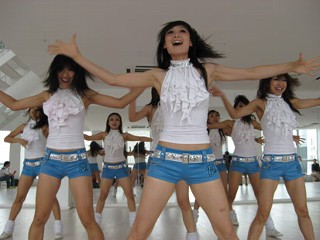
One of the newest developments in the realm of Chinese sport has been the interest in cheerleading and cheers competitions. Since before the 2008 Beijing Olympics, there has been a drastic increase in mainstream fascination, participation and expansion of the "sport". Although this seems like less of a blog-worthy development, it is still an interesting aspect of Chinese culture that is changing.

When I first arrived in China, there were very few, if any cheerleaders of any kind. Although there were forms of dance in traditional Chinese culture, there was definitely a lack of a performance art that combined athletic maneuvers, performance and peppiness. One can even make the argument that traditional Chinese culture frowned on this type of performance for it wardrobe and style.

Earliest forms of cheerleading in China were glorified jumping around of cute girls in relatively skimpy outfits during timeouts at Chinese Basketball Association (CBA - the Chinese national basketball league) games. These performances were often elementary and actually quite embarrassing to watch.

However, as the Backstreet Boys and Britney Spears influence on pop dancing (as well as Korean and Japanese pop) changed somewhat Chinese pop singers, this influence has also translated into the increased recognition and better accented moves in cheer circles. In the past months, there has been a noticeable improvement in everything cheerleading related.

During the preparations for the 2008 Beijing Olympics, cheerleading professionals from the US were invited to come to China to help mentor, train and develop girls who were going to perform at the games. In total, China trained 200,000 people to cheer in preparation for the Olympics. This national initiative really helped improve Chinese aspiring cheerleaders.


Without knowing how many Chinese schools have cheer programs, it is notable that many TV programs include cheer performances and competitions of many Chinese schools. There has been definitely an increase in peppiness.

While these programs are becoming more frequent, coverage of international competitions have also been broadcasted. As I am writing this post, I am watching the 2008 World Aerobics competitions on the main Chinese sports channel (CCTV5). Other events, including the US cheer championships usually held in Disneyworld, have also been given prime exposure to Chinese audiences.

Although this type of performance dance/sport is still in its infancy in China, it has been marked by notable investment and development (just as in every other industry in China).

Wednesday, January 28, 2009

Counterfitting the RMB

One of the most notable and influencial topics discussed by all of my family during CNY this year has been the availability of new high-quality counterfeit bills. China has great skill in duplicating things of all types - including electronics, dvds, shoes, bags, ect. Now it seems that someone has helped improve on counterfits that they have been passed into banks and atms. Anyone living in China deals with this issue everyday. There are fake 1 RMB coins all the way up to 50s being passed around in the population, but never at this rate and quality.

When talking to my Chinese uncle and his friends a couple of days ago, they hypothesised that the fake bills orginiated from Taiwan. They described it as a relentless competition between the mainland and taiwan. The goal is to access the others' financies and undermine the currency. They suggested that China has also done the same in Taiwan.

No matter what the origions are, it is still very intimidating to know that fake bills are so prevelent among the population. Friends in the banking industry who handle and count money everyday have also discussed the current situation and the different countermeasures the banks are trying to implement. However, when people depsoit the fake currency in the ATM, it is automatically recycled when others retreve money.

Here's a recent CNN report on the situation:

Thursday, November 27, 2008

Expat Frustration in China

China is a frustrating place.

There i said it. Everyone is thinking it. You know you are too.

I would like to first state that I love China. I was born here and have been living here for more than 2 years. I have family here and a lot of friends too. I feel a incredible pride of being Chinese in the current state in the world as well as understand the burden of its history. I really do understand. It's in me.

As much as I enjoy living here, I have found China to be an incredibly frustrating place to live. People from the outside would make general arguments for this fact... ie. the water is dirty or the air is polluted, but the real frustration comes from all of the little things. These little things cant be seen or even understood by someone who hasnt lived in China. It builds up slowly until one day, you know you have to just get out of here.

When one first moves to China, everything is new and exciting. It can even initially be fun and interesting as something that is embrassed. However, given the right amount of time, these things become less fun/interesting. It's ok to laugh it off for a little bit of time, but after actually living with it everyday.... things change. Of course all of these little things can be properly explained and put into context of cultural difference, social development, a large population, ect. As a visitor in any new country, one has to accept the local society and its customs. However, that doesnt make day-to-day life easier.

So what are these little things? Here's a list:

1. The inability to just relax. The sheer number of people in China makes it so that is are people EVERYWHERE. I have never been anywhere where it was just me and no one else - where I can take a deep breath and get away from it all. 就不能安静下来. Even in places like your own apartment, the bathroom or anywhere else private, there are tons of ambiant noise caused by all of the people.

2.The horrible service. Although the general service is improving, it still lacks a huge amount to a solid benchmark. Examples include:
  • Waiting for hours in line at the bank where there is only 1 teller serving dozens of people
  • Any small mistake on any form will mean redoing that form
  • The amount of BS paperwork and incovenient transaction materials for just about any service including banking, general utilities, phone, ect.
  • Really long waits for any service at restaurants where a question or request can be left unanswered for more than 15 minutes
  • Some employees telling you the wrong thing while managers tell you the right thing
  • Basic lack of common sense where the idea that the "customer is right" doesnt exist
  • General inefficency
3. Lack of common courtesy by (not all) people. This issue depends on city and location, but it definitely happens just about everywhere. It is worst in a place like Shenzhen where there is a large migrant community. Although not all people are so bad, the small percentage of 1.3 billion is a lot. Some examples are:
  • Spitting on the street to spitting on the floor indoors and even airport terminals
  • Blatent littering when trash cans are close by (I've found myself picking up after other people)
  • Smoking in McDonald's or other non-smoking places
  • Not waiting in line for anything and pushing your way through to the front
  • Really loud disturbing conversations in restaurants or on cell phones
4. Life threatening transportation. With more and more cars on the roads everyday, the streets are not only more conjested but even more dangerous. Some basics are:
  • Taxi drivers swirving left and right in and out of traffic
  • Drivers sometime ignoring red lights or going in the wrong way on a street
  • Cars parked waiting for someone along the side of the road that blocks off traffic for
  • People standing in the street for buses
  • Jaywalking on really busy 8-lane intersections
  • People dragging carts along the street filled with random stuff.
5. For people not of Chinese decent, they get stared at all the time and approached with hi's, hello's and impromptu conversations. That's cool for a while but it gets annoying too.

All of these isses and problems all combine after a certain amount of time to build up incredible frustration in just about everyone I know. Good people become the epitome of the "ugly American" with this built up in their system.

I was talking to a friend of mine who is the nicest girl you would ever meet. She told me a story of how she just flipped out at a taxi driver after he said he couldnt take her to her destination becuase he was about to go off duty and had to return the car. She felt horrible afterwards and felt bad for the taxi driver who was only doing his job. That didnt prevent her from venting out yelling at him. That's something I would never expect from her.

Even my mom agrees. She has lived 60% of her life in China and 40% in the US. She comes back on business trips every year and loves it for a while. However, she would never be able to live here for an extended amount of time anymore.

I've seen myself become increasingly frustrated over time as well. After a while, you just cant help it but to be chippy douche to people, even friends. It's just one of those things. Maybe this is why all of the Chinese rich people are moving out to places where there are less people.

The only remedy is to get out of China for a while and go on vacation. The key is to get back to a place where these small things dont exist, or that they exist but are interpreted by a tourist mindset of acceptance, not a constant annoyance. Thank goodness Shenzhen, is so close to Hong Kong, Macau and SE Asia. A couple of days on the Thailand beaches really does wonders. Bali, here I come.

Tuesday, November 25, 2008

Sex, Love & Money in China

Anyone who knows anything about Shenzhen knows that it is the "wild wild west" of Chinese capitalism. Although some would argue Shanghai or Hong Kong as the major financial centers, Shenzhen is the real place where all the most able and capable entrepreneurs go. Maybe in 10-20 years, Shenzhen will develop into a international city, it is still currently a culture-less metropolis with a specific focus on money and everything money related.

I like describing Shenzhen as a melting pot of the most able people in China. The young worker in the factory is usually the eldest and most responsible or able in his/her family while the company owners are hotshots from every part of China. It is certainly a weird and unique place with a young population that like to get ahead.

One of the more interesting and somewhat unfortunate aspects of his money-hungry city is its hidden cultural intersection between sex, love and money. Here's the rule: those who dont have money will do a lot to get it. In this case it has led to a system of mistresses and

In a article published online by Telegraph.co.uk entitled "China girls: 'The only luxury we can't afford is love'", it describes the current and growing issue of 2nd wives and "concubines" in China. It follows a variety of individuals who are in this community of "二奶 [ernai]" and discuss the various social, political and personal issues that are involved.

Anyone who lives in a major city in China can see the various signs of this system. It is as simple as going to a club/bar on a weekend and seeing all of the 40 year old guys sporting the beer belly with a young and attractive girl in her 20s.

Even yesterday as I rode the elevator down from my apartment building at dinner time, I chatted with a really pretty girl in her 20s. I noticed that she was wearing expensive jewlery, clothing while radiating Channel purfume. As we parted ways outside of the building after some small talk, I saw her go directly into a high priced Mercedes waiting for her, driven by a 40-something guy.
Most 二奶 receive "rental on a fashionable penthouse in one of the city's dazzling white apartment blocks, plus a 5,000-yuan (about £350) monthly budget for clothing, haircare and skin-whitening treatments. That's more than double China's average monthly income."

In turn her 'husband' - a successful industrialist whose factories stud mainland China - entertains Little Snow once or twice a month. The nights are raucous, but the sex lacklustre, to Little Snow 'a function no different from brushing my hair or drinking a glass of water'. He's up before the sun rises, sometimes leaving a rose on the pillow.
Is this wrong? Is this right? I don't know. However, I do know that this is all created by the income disparity that exists between people from the countryside and those from the cities, between the young and old, between women and men.

As long as men in China have most of the wealth and the distrubution disparty between the different classes are so large, this system will always exist. As the Telegraph article states:'
The country has changed rapidly; but Chinese thinking hasn't caught up with this new reality,' says Yang Erche Namu, aka Namu, one-time mistress to a diplomat and now a postergirl for modern Chinese feminism, whose ballsy bestselling books urge Chinese women to pursue emotional and financial emancipation. 'Some men are getting very rich, with cash to throw around, but at the same time the wealth gap is widening and the countryside is full of young girls living in poverty. So it's natural that love becomes a transaction - it's a simple case of supply and demand.'
In addition to the young 2nd wives, there are also 2nd husbands, gigalos or 鸭子 [yazi] in Shenzhen. While this usually occurs less frequently, it is still a part of the culture. A recent Malaysian article described a young, 22 year old Shenzhen man blackmailing his 50 year old wife for 1 million HKD.

This just shows that its all about the money in Shenzhen.


Note: Many people have written about the issues relating to prostitution and brothels in Shenzhen and other Chinese cities. I have been recently reading China Inc. by Ted Fishman and it gives a great summary of the situation for girls who go into the pay-for-sex industry and its links with economic and financial struggles.

Also, just to show that Sex & Money is related in every culture, below is a recent ABC News report describing the growth in the US brothel service in the current bad economy.


Wednesday, November 05, 2008

Unity in the USA and China

I spent last night with a couple of fellow American friends to watch the complete and full election coverage on our little 3-monitor setup here in Shenzhen. After a rather quick electoral landslide, Obama will become the next President of the USA. This almost improbable moment just years ago - in a country with a racist and problematic past, the US voted for change.


Even though I am on the other side of the world, watching what is going on through video monitors, I could still feel the great aura of the moment. I could almost feel the excitement and sheer awesomeness felt all over the US. Many friends emailed, texted and even called me talking about their excitement, where they were and what was going on. Some partied in the streets of Harlem on the 125th and some were present at his acceptance speech with 70,000 others in a Chicago park. Just a great moment.

This moment, that brought together millions of Americans created a new communal feeling of togetherness and unity that has not touched the US for such a long time.

In actuality, this moment resembles a lot of the past few years in China. Yes its true. As much as a lot of people criticize China for "autoritarian gov't" and other "non-democratic" ways, it is a place that has this collective conscienceness.

Thinking back, I remember when China was awarded the 2008 Olympic games way back in 2001. I was in China for a few days and saw the millions of people celebrating in Tiananmen Square and all over the country. I remember the Sichuan earthquake and how that brought the Chinese people together. I experienced the sheer awe-inspiring 2-week Beijing Olympics and the subsequent liftoff and the 1st space walk of the Shenzhou 7 mission. All of these events (among others) are underlying reasons why China has been able to become what it is today.

Again this feeling of community, the collective idenity and conscienceness creates a great feeling of unity. With the looming economic crisis increasing in scope, this is exactly what the US needs. Just as it united the USA after the attacks of 9/11, it will make the country resiliant and powerful again. Even though i'm over here in China, i'm proud of my country and see a bright future ahead even with the problems that will come. For a country to be able to build the A-bomb and go to the Moon, nothing is out of reach.

Sunday, October 26, 2008

Shenzhen's Greater Plan: No Manufacturing, No Problem.

There has been a recent plethora of news regarding the effects of the global recession on the Chinese export industry, especially in Shenzhen. Many articles have been devoted to bigger factories that used to produce toys, furniture, other consumer products while employing thousands and thousands of workers closing down. One even says it will cost the Pearl River Delta area "millions of jobs".

In reality, this situation has been going on for a while now. The downturn in the US economy many months ago changed the dynamics of manufacturing. With changes in regulations and demands, rising RMB vs. the Dollar exchange rate and other factors, previous factories that employed 100-200 workers couldnt maintain cash flow and pay for their workers.

While talking to managers at plants, some said that it was better for them to go idle than to manufacture something because the things they made was almost always at a loss. Other factories didnt even have the convenience of deciding to manufacturer or not. Once booming factories couldn't get any new orders from their clients in Europe and the US. No orders = no work = no jobs = plants closing down. Fast forward to the present and we see factories with 2000 workers collapse. That's intense. I've seen recent stats that more than 50% of all toy companies in Shenzhen have closed down.

The thing is, as much as this economic downturn in the globalized economy has hurt a lot of export-driven businesses, and its workers in Shenzhen, it's really helping Shenzhen transform itself to what it wants to become. For the past 2 years since I've been living here, there has been a constant trend and push by local officials to develop Shenzhen as a city dominated by high-tech research rather than lower value-added manufacturing. It wants to go from labor intensive, basic and easy things like the toy industry to industries higher on the totem pole of innovation.

As much as Shenzhen was able to get its start from being that factory town "across the border" for Hong Kong businessmen, its goal is to move away from that persona into an international city of something other than toys, eye glass frames and furniture. It wants to be a city on the same scale as Beijing and Shanghai, or better than Singapore.

So while Shenzhen has slowly tried to shed its own manufacturing persona (these are well documented and that I wont go through), it has done many things to promote innovation, whether its opening a office in NYC or being ranked a leader of innovation in Asia in a recent study. Other things include:
  • Establishing favorable policies for high tech industries - this includes lower taxes and cheaper office buildings (among others)
  • Attracting more and more Chinese people back from overseas, whether its recent graduates or seasoned professionals and intellectuals.
  • Maintaining a high education work force. Supposedly more workers in Shenzhen have advanced degrees than any other city in China. I'm sure most of these are in fields of engineering, mathematics, ect.
  • Increasing its financial clout. Shenzhen has developed the Nasdaq-style exchange for SMEs (adding to its current Shenzhen Stock Exchange) while more and more investment banks and financial companies are established here.
  • Promoting greater cooperation with Hong Kong (which is definitely an international city). This work might culminate into a "mega city" metropolis of 20 million people that combines both cities.
  • Investing in an amazing, state of the art Terminal C at Shenzhen Airport.
  • There has been recent emphasis on art, music and culture in the predominantly money-hungry and business rich environment.
  • Focusing on the legal industry. Peking University recently opened a regional campus in Shenzhen as the 1st American-type law school in China. They even invited Justice Anthony Kennedy from the US Supreme court to give the Keynote at the dedication ceremony.
Shenzhen already can be considered one of the most expensive Chinese cities and its development for the future looks bright. Even with the global economic downturn, UPS has just started construction on its new Intra-Asian hub in Shenzhen and it has been ranked 10th on the list of "most powerful emerging cities in the world."

I don’t think anything will stop the development of Shenzhen into the international power city it wants to become. As long as there are no unforeseen problems with the unskilled laborers who have been getting laid off at factories. If you want to get in on the Shenzhen story, better buy a house now before the prices start going up again.

Monday, October 13, 2008

Healthy Eating in Shenzhen

Ever since I returned to Shenzhen from my incredible Olympics trip to Beijing, I have put myself on the Mike-diet/exercise plan. It is a strict regiment combining working out, health living and healthy eating. When I implemented my plan back in college, it worked wonders. I lost weight and increased my muscle mass - perfect for spring break at the beach.

One of the most difficult things to keep up with during my diet is eating healthy. Back in college, although John Jay dining hall and all the other Columbia University places for food wasn't overwhelmingly great, they still provided a lot of options for low-calorie diets. I could go in, pick up some grilled chicken at the salad bar with some egg whites. In restaurants, there were always options for meals that were more healthy - low in cholesterol, low fat/oil and low calories.

Food in China is much harder to deal with. Unless I cook the meal myself, I really don't have too much confidence in the contents of food... healthy-eating wise. Don't get me wrong, Chinese food is clean, really delicious and cheap, but on the oil usage side, it leaves something to be desired.

With the price of food skyrocketing in recent months, its only logical that small restaurants would want to conserve costs in every way possible. This presents even more problems with a healthy-eating lifestyle.

Here are some of the issues I've been experiencing.
  • Often times dishes are covered in oil and are high in salt content. Salty foods makes you want to eat more rice = hidden calories
  • Lots of dishes are smothered in thick, rich sauces. While these sauces taste awesome, they are another source of hidden calories.
  • The price of pork has increased by more than 50%. This means restaurants use more fatty pork in their dishes than they would traditionally to reduce cost.
  • Restaurants sometimes use old cooking oil that has been used in friers. As with the same problem in McDonald's fries, repeated use of the same oil is unhealthy.
  • Eating at Chinese restaurants can be problematic with regard to portion. After having a little bit of a lot of different dishes in a potluck/communal way, its really difficult to measure how much you are eating.
  • Only relatively healthy American establishment is Subway. Since I live more than 5 miles away, it's not a viable option.
The only main restaurant I order food from is a local Korean restaurant. The selections are cheap and diverse while carolie and fat content stays low. Kimchee soups only cost 20RMB with starter dishes and rice. Not a bad deal. Other than the Korean restaurant, I usually cook at home. While I make just about the same things as local restaurants make, I can better control the quality. By using olive oil (100RMB/liter), less salt and sauces, it's the best way to eat healthy in Shenzhen.

Here are the main foods that I rely on available at the local supermarkets:
  • Boneless chicken breast is available everywhere. Although Chinese people generally love pork, for some reason, stores sell chicken breast too. For about 6RMB, I can get a healthy portion that I cook on the George Foreman grill after marinating it in soy sauce.
  • Canned tuna is widely available as well, but a little expensive compared to the US. Individual cans go for about 11-14RMB at the foreign foods aisle.
  • Salads are big for me. Since veggies are relatively cheap, its a good way to eat healthy. The only thing is dressing selection is limited. This means, I buy dressing every time I'm back in the USA.
  • The availability of cheap sandwich meats have been a recent phenomenon. Pastrami, ham and beef ham cost about 7RMB for 10 circular slices. Place that in some mutigrain bread with some mustard and it kind of feels like the US.
  • For drinks, I stick with Dole OJ (16RMB fora typical jug), water and the recent introduction of Coke Zero to the Chinese market.

Sunday, October 12, 2008

Changes to the One Child Policy

I just got back from Shenzhen after an eventful weekend in and around Chengdu. I went with a friend to her cousin's wedding back in her hometown. We hung out with her huge extended family and had a wonderful time. Even better, this trip has given me a lot of interesting topics to write about for my blog.

One of the more interesting topics I stumbled across was a new regulation regarding the 1 child policy. Officially adopted in the early 1980s as a way to control population growth in China, it stemmed from the fundamental belief that society is a big stakeholder on everyone's life. Given China's huge population, in a person's life, not only does he/she need food and shelter, but also the opportunity to go to school, find a job, have health care, ect.

It's not only a family decision to have a child, but a big part is society's ability to support this person throughout his/her life. In a country dominated by overpopulation and not enough resources even more people is a big problem. While there were some exceptions made for ethnic minorities, people in rural areas and people living in mountainous habitats, the rule was otherwise strict. Violators faced fines and other actions, sometimes including sterilization (reported).

Due to the importance placed on having a son, the government also placed strict laws against families finding out their baby's sex until he/she is born. This would prevent families wanting to abort the pregnancy after finding out they are having a girl instead of a boy. Although this policy can be circumvented through some back-door guanxi at the hospital, it's proven relatively effective.

The 1 child policy also changed the basics of family dynamics in China. As an only child myself, I didn't have any brothers or sisters. My mom was the oldest of 3 while my dad was the 2nd of 5. My grandparents were both the youngest of 7. Traditionally big families all over the country were now only allowed one child. No more brothers and sisters just cousins. In a country where family is really important, this is a big deal.

There have also been bigger problems that have come out of the 1 child policy. In a disturbing report by Al Jazeera, child abductions have been more and more frequent.

I personally agree with the 1 child policy. Although western "human rights activists" oppose it, the 1 child policy has been one of the reasons China is not at a 2 billion population right now. While having a child can be considered a right, the ability for this child to live in society is just as important or even more important.

It seems like the rules have been modified a little bit. From my conversations with numerous people on this trip, it is said that if a couple are both the only child from their respective families, this couple can have 2 children. I don't know if this is absolutely true across the country, but my friend confirmed this fact. (She and her husband just had a baby girl 5 months ago).

Although this doesn't seem to be much of a concession, it feels really big. It gives couples more opportunity to have the boy they sometimes greatly desire. It also signals a shift in the belief that China's society can support more people in the future given its economic development. Maybe its also the need for more young people in the future to support the aging population. Whatever it is, it's a big change.

Saturday, October 11, 2008

2008 Beijing Olympics: Volunteers EVERYWHERE!

Immediately after the closing ceremonies, there were nonstop coverage by the Chinese media on the end of the Olympics. As every event completed its final game or match, the final medals had been handed out and the crowd had left, only the volunteers were left.

After a month's long work as an Olympic volunteer it was a perfect time to relax and unwind at the venue they had worked so hard in. People were running around the bases in the baseball stadium and taking pictures in the beach volleyball sand in Chaoyang Park. Everyone was enjoying a job well done and a successful Olympics.

The number of volunteers that were employed during the Beijing Olympics was unbelievable. Not only were there thousands of official volunteers selected by the city, there were also local mobilization of citizens. At all of the major tourist sights, in the subway stations, on the streets, in the small neighborhoods and everywhere in between, there was someone to help out. All of these people were constantly looking over Beijing - making sure it was safe, friendly and welcoming to both the athletes, coaches and tourists from all countries.

As my mom’s friend in the China All Women’s Federation said: Just give these volunteers a T-shirt and arm band and they’ll mobilize together. These old people in the neighborhoods constantly gossip and know just about anyone. Terrorists? Yea right.

Here are some of the volunteers I came across:

At Wangfujing - these people know 4 different languages


A girl got lost in the metro station! Here come the volunteers.


China Mobil Volunteer station near the Beijing Military Museum


Old People hanging out


Young People hanging out


Everyone's an volunteer.


China Mobile Volunteer Stand near the Guo Mao area


Thursday, October 09, 2008

Craigslist Enters the Shenzhen Online Community

While browsing online yesterday, I noticed something new to the Shenzhen online landscape.

For people who don't live here, most people go to Shenzhenparty.com for just about everything including applying for jobs, parties, classifieds and apartment hunting. It is the most dominant site in the area. While there are some issues with its graphics, interface and user-friendliness, it is a useful platform that just about everyone embrases.

In recent months, Shenzhenstuff.com has developed a nice, more interactive site in the Shenzhen online community with it's Ning platform for social networking. This site has personal profiles, fictures, blogs, news and message boards. It has become a hit for both expats and English-loving local Chinese. While sometimes it is more of a place for weird white guys to hit on random Chinese girls, it does create a interesting interactive community.

Recently in response to this more interactive community, Shenzhen Party has started its own Ning-created network to comepete with Shenzhen Stuff.

The newest addition has been the addition to Craigslist. Originally started in NYC, it has now spread to China to 6 cities - Guangzhou, Shenzhen, Hangzhou, Beijing, Shanghai and Hong Kong. Although Craigslist: Shenzhen has very posts and relatively few users currently (it's only been online for a few months max), it creates an interesting new addition to the Shenzhen's expat market. I wonder if Craigslist has or will be opening up a Chinese language version of its services soon. That would be a much better investment with a possibly much greater pool of potential users.

Tuesday, October 07, 2008

Chinese Health is Trending Towards Obesity

China is getting fat and less healthy. It's true.

I first wrote about this problem more than a year ago with my analysis of McDonald's in China. Others have also ventured into this realm.

A USA Today article written more than a year ago, Obesity of China's kids stuns officials, described the shocking changes in Chinese children.
New figures from the Health Ministry show that urban Chinese boys age 6 are 2.5 inches taller and 6.6 pounds heavier on average than Chinese city boys 30 years ago.

The average 6-year-old in Beijing or Shanghai weighs nearly 47 pounds and is 3 feet, 10.5 inches tall, ministry figures show. The average American of the same age weighs just over 50 pounds and also is 3 feet 10.5 inches tall, according to data from the U.S. Centers for Disease Control and Prevention.

Chinese children have a lot of factors working against them in the battle against bad health and obesity:
  • Children are traditionally considered more healthy (and better) if they are fatter.
  • Due to the 1 child policy, Chinese children are often spoiled by parents and grandparents - meaning more trips to fat-happy places like McD's.
  • The demands on a child's academics is such that some kids start going to after school classes when they are as young as the 3rd grade. More classes = No playing outdoors after school.
  • When students do have time on their hands, its often spent online playing games like CounterStrike, WoW or chatting on QQ. This not only results in muscle atrophy but also a decreased people-skills ability.
  • There are very few, if any, outdoor clubs and organizations to join. In the US there are basketball, soccer, football teams, little league, boy & girl scouts. In China ... I've never heard of any.
  • When kids get into high school, academics is still the end all be all preparation for the College Entrance Examination (高考). School sport systems are very rare and active lifestyles really disappear.
Even after kids grow up, there are many other things working against them.
  • More meat and dairy products are available due to increased economic development. Many Chinese enjoy strictly eating meat almost exclusively. This is even worse when meat is usually prepared with a solid layer of oil/grease.
  • When graduates enter the workforce they usually find white collar jobs. Instead of physical labor, people sit next to their computer day in and day out.
  • With more and more cars on the road, people are travel less by foot or bike and more by car.
  • It is very difficult to eat healthy.
Due to all of these factors (and others), it is not surprising that Chinese people are getting less healthy and more obese.

I can state from personal experience that this is occurring. My cousin in Harbin is 18 and is starting college next year. He grew up as the "little emperor" and was a cute, chubby kid. My extended family obsessively fed him while focusing stringently on his future academic prospects. He was decent at school, but he was aided with constant help and review classes beginning at age 10.

My cousin never really played any sports nor did he even go out to hang out with friends. (I honestly dont know if he has any friends). The only things he does is stay home, go online, study and eat. The expectations on him by his parents and grandparents are to study. I dont know if he even does chores around the house.

What began as a promising kid is now a rather fat, unmotivated, friendless and people-skills-less person who grew up like many other kids in China. I honestly dont know how he's going to survive in modern society.

Of course, China isn't standing still waiting for this problem to expand. There has been not only government initiatives to step obesity but also private sector developments. Re-examinations of the educational system and parental responsibilites are also occuring.
  • Fat camps have popped up all over the country for obese children. TV programs similar to the US "The Biggest Loser" are also appearing on TV.
  • Chinese people, while getting more lazy and less active are still relatively more active than counterparts in other countries. The use of public transportation and walking in China helps this cause.
  • Chinese people for some reason enjoy climbing up and down mountains as weekend functions of fun. That definitely helps.
  • Some more affluent Chinese families are promoting a more healthy and active lifestyle for their kids. This includes more traveling, more exercize and joining clubs
  • Basketball is increasingly popular meaning more people are excercizing everyday.
  • Preventative health is big in China. People often eat vitamins and stay away from pain killers and antibiotics.
  • In my opinion, however, the biggest development has been the huge expansion of exercise in cities among the urban population.
Hopefully all of these factors can help the Chinese people develop in a healthy and sustainable way.

Tuesday, September 30, 2008

WWE Wresting is in CHINA! WHAT?!?!

As I'm writing in my blog right now, I have the Guangzhou sports channel on (Channel 67 on Shenzhen's local cable). To my surprise, the programming being broadcasted right now isnt a European Champion's League soccer game nor is it a replay of an 2008 Beijing Olympic event - that has been often on TV recently. It's not even a boring strategy guide of Chinese chess.

No. It's WWE's Monday night RAW with John Cena wrestling in a 2 on 1 event.

What?!

Yes. You heard it here. The World Wrestling Entertainment is here in China. As I've noticed in the brief time I've been checking the show out, it seems like unedited segments of the live events broadcasted in its natural form. The viewer can hear the English broadcast, plot lines and music but the entire production is voiced over by a Chinese commentator. This guy explains each wrestler's history, their technique and special moves, the plot lines, situations and almost a play-by-play of the matches. I wonder how these commentators made up the Chinese vocab for a Stone Cold Stunner...

Best Quote: "[In Chinese] Don't do these submission moves at home, kids."

What is with WWE events being broadcasted in China of all places? What are they thinking? Although I dont know if fake wrestling is as popular here in China as it is in the midwest and south in the USA, I do know that the WWE is making a play at the China market just like the NBA, MLB, NFL (not to mention just about all other western companies).

In my opinion, it's incredibly funny that this is on TV here in Shenzhen, China. If Chinese people actually watch this programing, what would they think about how crazy US sports are. I wonder if the China version shows the girls wrestle in skimpy bikinis too??

Monday, September 29, 2008

Shenzhen Gov't Make Arrests After Deadly Fires

In the past few days, the Shenzhen government has taken action and arrested more than 2o people in association with recent unexpected fires in the SEZ.

The first action, 13 people were arrested for the fatal fire that killed party-goers at a Longgang night club a week ago. As China Daily reports, Investors, club workers and founders were all taken into custody for their involvment and neglegence in the event.
As of 12 am on Friday, family members of 31 victims of the fire had signed compensation agreements with the local government, according to the Longgang district authorities.

The Longgang district government is paying kin of those who died 250,000 yuan.

The property of Wu Wang Club has been frozen and the lawsuit over the fire is expected to take a while. Family members of the victims can file a suit and claim for compensation from the frozen club property. The club will pay back the government after the court ruling, said Huang Wei, spokesman for the Longgang district government.

Some 43 people injured in the fire are still in hospital. Four of them are on life support. Medical experts assigned by the Ministry of Health said the injury to their nervous system as a result of suffocation is most likely beyond recovery.

Despite a citywide drive to preempt such incidents following the nightclub fire, a fire broke out at an old factory of a Taiwan-funded company in Shajing of Shenzhen's Bao'an district around 4 am on Friday. It was put out in five hours. There were no casualties.

On the following day, Xinghua reported the arrest of officials allegedly involved a factory fire that happened back in February in Shenzhen.
Nine people including four government officials have been arrested in connection with a fatal factory fire that claimed 15 lives in Shenzhen, south China's Guangdong Province, in February.

The four officials, identified as Huang Hanguang, Zeng Hongbo, Lin Guozhong and Yi Rao, were from the city's fire fighting bureau and environment protection bureau. They were arrested on charges of neglecting their duties and misconduct, said the press office of the Shenzhen government on Sunday.
As I have seen personally in the past few days, hopefully this kind of attention will bring greater awareness for fire safety in the city.