Showing posts with label Transportation. Show all posts

Thursday, January 27, 2011

RVs in China? Doesn't Make Sense

During my time “deep undercover” in Shenzhen, I saw that smaller Chinese companies really put an emphasis on foreign imported products, especially from Europe and the US. Higher class consumers have a lot of discretionary income and wanted the best products. This meant that imported goods were seen as the best.

This sentiment led a lot of small businesses to register their company, trademark their product and acquire businesses in Europe and the US. Now, businesses can claim that “this is a US product” even though Americans have never seen it. It doesn’t hurt that the RMB appreciation and depression of US/European asset prices are making things a lot cheaper.

China is a potentially huge market for many foreign products. Luxuries goods, cars, airplanes, vitamins, cosmetics, ect.  have all succeeded. This recent exuberance for the foreign products has quasi-blinded some business people in China.

One recent article I read in the LA Times titled "China has burgeoning market for RVs, entrepreneur says" made me laugh. 

China is hungry for the kind of recreational vehicles built in Southern California — at least according to the Chinese entrepreneur who struck a deal with a Riverside firm to build and export $5 billion worth of them.

The Chinese government has placed a focus on developing the RV industry as a cornerstone of the Chinese ideal of the happy home life, said Winston Chung.

"A family with an RV is a family more in harmony with each other," he said, speaking through a translator. "During vacations, people can get into the RV and enjoy quality family time."

Under Chung's agreement with MVP RV of Riverside, the company plans to manufacture the vehicles here and export them to China. However, Chung would not rule out moving operations to China in the future.

Chung spoke about the burgeoning market in China for the motor homes after a news conference with UC Riverside Chancellor Timothy P. White, where they announced Chung's $10-million donation to UCR's Bourns College of Engineering.

In an interview with The Times, a smiling Chung cheerfully detailed his plans to build and export 30,000 diesel-powered motor homes to China, and eventually to develop electric-powered RVs. Chung, 52, is the founder of battery maker Winston Global Energy.

The nascent Chinese RV industry has the potential for high profit margins, despite high taxes on gas-guzzling vehicles, Chung said. He added that the increasing value of the yuan, the Chinese currency, will make buying an RV more affordable for families. 
Yes. These RVs would be more affordable, but who would buy them?? Let's analyze.

  • China has 1.3 billion people in a limited amount of space. People all live in high-rise apartment buildings to save space. Even those people who bought traditional American houses are squeezed together to an uncomfortable small area. There is just no room to park these things that would actually make sense unless its in a parking garage - but thats expensive.
  • People in the US enjoy RVs for camping and exploring the country - esp in the midwest and western US. It takes advantage of the cheap(er) fuel prices and the interstate highway system with the comfort of your own hotel-room RV. In China, tolls for the freeways are very expensive and the gas isnt cheap either. It doesnt make sense to travel via RVs since trains, long distance buses and plane travel is so convenient and public transportation and cheap taxis are available everywhere. Also, hotels are cheap as well. 
  • Mostly older people in the US have RVs. Chinese old people dont know how to drive.
  • The people with the most RVs/Trailer homes in the US are for the poor. However, I dont foresee poor Chinese people choosing to live in RVs rather than their houses. 

To me, RVs just does not make sense in China. However, if Mr. Chung and his company, Global Winston Energy bought the company to cut costs and sell to US/Canadian consumers (just like Chinese car maker Geely bought Volvo), that would make some sense.

Otherwise, what are you thinking??


Wednesday, February 04, 2009

Shenzhen Mass Transit: For the People

During the Spring Festival break, I was able to spend time and talk with my extended family at the different dinners and tennis outings we had. At one of the outings, I had to chance to discuss the Shenzhen public transportation with my aunt's colleague - an official who is in charge of government municipal projects. Currently Shenzhen is going through a massive expansion of its metro system. 

When discussing the effects of the economic crisis and the current government investment in infrastructure, our family friend mentioned that currently, the Shenzhen metro system had an operating loss of 500 million (五亿) RMB in the past year. That's a lot of money. 

I was first stunned at this number and was interested in why this is the case. The Shenzhen metro system is already the most expensive in the country with a graduated ticket price based on distance. Also with increasing traffic congestion, more and more people are choosing to ride the metro everyday in their commute. Even with these factors, the operating cost of the metro is still much higher than the revenue. 

As the official explained:
The metro runs as a regular company, but with the Shenzhen government as the controling party, we set the ticket prices. Our goal is to provide affordable transportation for Shenzhen citizens.  We make sure that the bus system and the metro system are not profit driven so that we can give the citizens a great service at a reduced price. This is also why all people over the age of 65 ride free of charge as well. 

As the expanded network comes online, we believe that even more people will ride the metro based on its convenience. Shenzhen will be a much different city. We believe the 500 million loss we incur every year will be reduced but in reality, that isnt too important. Cheap, reliable service to the people are.

When comparing the Shenzhen metro system with the NYC subway, there is a huge difference in thinking. Because the NYC system is profit based, price fares are constantly rising with subsequent lower service and convenience. I remember a few years ago, the MTA wanted to increase the fare price because of a loss while trying to hide millions of dollars worth of revenue from the public. 

The government promoting public transportation in China not only helps the citizens, it helps reduce the use of private cars and improves the enviorment. Currently China is building more than 10 different subway lines across the country with more planned. This is on top of the increased investment on railroads and other mass transit systems. 


Thursday, August 09, 2007

Chinese Bus Inspection

I hate working on Saturdays.

I’ve said it once; I’ve said it a thousand times. Working a half day on the weekend really changes my whole routine…and it’s probably one of the more annoying parts of my job.

However, every time I commute to work to work on a Saturday, it seems that I see something interesting. Last time I wrote Shenzhen: Diversity of Languages that was initiated from my Saturday bus ride. On my most recent Saturday commute, I saw something interesting regarding regulation of buses.

I have a lot of choices for buses going from my apartment to the factory. Although there are direct buses that do the job, when I’m pressed for time, I take more frequently occurring buses and transfer later. I would take the first bus about 90% of the way and get off at the 沙弯海关 stop. I would then wait for a Shenzhen mini-bus (which is still allowed to operate outside of the main city limits) to the front of the factory.

On this particular day, I was waiting at the沙弯海关 stop and saw a group of 3 men in official uniforms, hanging out at the stop. I didn't make that much of it at first, but when a minibus finally arrived, it got pulled over. One of the men in uniform boarded the bus and asked for the workers to get off. From a distance, I could see the officer examine the interior of the bus. The bus driver quickly and very “graciously” showed the officer all of his proper paperwork for the vehicle as well as the necessary worker permits for the employees.

Although I thought the inspection was interesting, I was initially more annoyed than interested. My boss at work gave people shit for being on time. If you were late, he would castrate you in front of everyone. With this in mind, I was constantly waiting for other buses that would take me the final few stops.

During my wait, 3 buses came and went without stopping at the designated stop. Just as these buses were slowing down, the driver would notice the minibus being examined by the officers and speed off. When I noticed that no one wanted to be inspected, I just had to find out more of what’s going on.

As I walk back towards the minibus to talk to the 2 officers on the side, I noticed that the examining officer was now onto the bus exterior. The officer walked around the minibus, checking out the bumper, the sides, license plates, everything. It was definitely very thorough.

When I asked the officers what was going on, they explained that this was a standard inspection that takes place every 2 months. They are looking for anything that violates safety and regulatory standards for buses. There were also supposed instances where some buses were “fake”. These black buses were not registered and were impersonating real buses. (Anything is possible in China).

The minibus ended up passing the inspection which took about 8 minutes total. And since no other buses were stopping, I quickly got on. As we left the stop, the driver quickly got onto his cell phone and radio intercom to warn other bus drivers that an inspection was happening at the沙弯海关 stop. I guess everyone wanted to avoid these safety exams.

I guess it’s just another day in Shenzhen, China.

Tuesday, April 24, 2007

Shenzhen Driver Licenses for Newbies

A lot has been made about the Auto Shanghai 2007. A Shanghai Daily article entitled China shows prowess in clean-fuel vehicles describes the situation:

China topped Japan as the world's second-largest car maker last year, with sales up 25 percent to more than 7.7 million units.

Homegrown brands increased their share of the passenger car market to 30 percent last year from 25 percent in 2005.

This year an unprecedented number of homegrown brands showed off their latest efforts to embrace the cutting edge of automotive technology.

Chinese car makers have been increasing efforts to develop new designs and build their brands into household names since last year, but the car show is the first major opportunity for them to showcase their research and development on the vehicles of the future.

Early last year, Shenzhen media announced that there were 1 million registered cars in Shenzhen. Although this may be a surprise for everyone driving on shenzhen’s streets (since it seems more like 10 million), it’s true and will soon get worse. Officials projected that by 2010, the number of cars will double to 2 million.

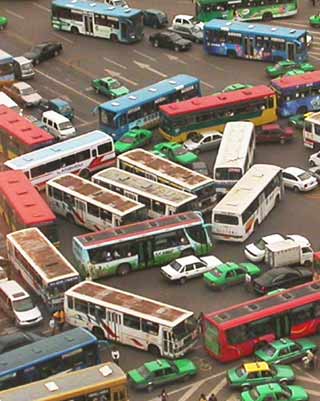
The potential growth in the market and the optimism for its future development is slowly being clouded by the situation on the ground. Traffic jams occur every day in every city. Cars are impossible to park and the streets are becoming more chaotic. It might even feel like the social fabric is slowly unraveling. (Check out my post, Blackout Shenzhen? Felt like it. for more.)

A recent Shenzhen Daily article, Driving license scam exposed, sheds new light on the increasingly worse situation.

Nearly half of all new drivers in Shenzhen obtained driving licenses from other cities without undergoing proper training…[where] local training schools arranged for one-day tests in other cities, including Shanwei in Guangdong and Ganzhou, Ji'an and Jingdezhen in Jiangxi.

Some schools simply "sold" driving licenses issued in other cities, the paper said. Such driving licenses are usually issued three months after 4,500 Yuan (US$582) is paid, and no test is needed, according to the report…

[Just] before the Spring Festival this year, up to 2,000 trainees of a Shenzhen driving school took dozens of buses to Jiangxi to take part in one-day tests. Most trainees passed the test in the first attempt. The few people who failed initially all passed in the second attempt, the paper said, implying that the school bribed the authorities to make it easier for its trainees to pass the tests.

It is almost expected that scams like this would occur for obtaining drivers licenses. With the increase in the Chinese middle class combined with the increasingly high costs just to go to a driving school and obtaining a license, “entrepreneurs” are taking advantage where they can. I even recently saw a post on one of the Shenzhen expat forums where one person was offering a similar service for foreigners. For 1000 Yuan, this person would walk you into the test and tell you all the answers for the driving test. Quite a deal.

Hopefully the Shenzhen government can do more to prevent untrained drivers from getting on the road ASAP. Otherwise, ill be sitting on bus 106 for another 90 minutes just to get to work.

Saturday, April 21, 2007

Shenzhen Public Transportation Entertainment (updated)

LCD monitors are everywhere in China. They are in random mom&pop shoe shops in back alleyways... playing music videos and lobbies and elevators constantly showing advertisements of a guy wanting to help me better learn English.

I’ve written about the increased use of LCD monitors in Shenzhen’s public transportation before with my posts Cab Advertising and Shenzhen TV is also talking about Melissa Theuriau. In the past couple of days, I’ve noted a couple of things regarding these LCDs in taxis and buses.

Taxis:

  • LCDs only come on when a customer enters and the price meter is started. This means that now it doesn't annoy the hell out of the driver during the entire day, looped to the same stuff.
  • The LCD content for viewing is very eclectic. There are very few commercials, current events and information about the city (as I would have expected). Instead, a huge amount of its content are funny cartoons, British hidden-camera shows and music videos.
  • The mute button has been upgraded. Before, a passenger could mute the display so that he/she didn't need to listen to the programming. Now, the mute only works for one segment only. After the segment is over, the sound comes back on automatically. I’ve had to hit the mute switch 10 times on some of my taxi trips.

Buses:

  • There are about 2 LCDs on each bus, one right behind the driver and one right behind the back door.
  • The LCD display and content is linked to the bus’s audio speaker system. This means that it can be projected throughout the bus so that all customers can hear. It also means that when announcements are made on the intercom regarding stops, safety, ect., it is projected instead of the music video.
  • The content is just as random and diverse as in the taxis. I’ve seen funny stuff, serious stuff and news.

The coolest part about the bus LCDs is that it can tune into live TV. Chinese news broadcast is the same everyday. The CCTV national news comes on at 7pm followed by the Shenzhen local news broadcast at 7:30. On a recent trip to my friend Jason’s house in Shekou, I was able to watch both shows live on the bus. How cool is that? I’ve seen it only a couple of times in different people’s cars. It’s supposedly done through satellite or wireless technology, but the quality is perfect. This is such a conveneient feature for the fast-paced Shenzhen life.

Tuesday, March 20, 2007

Chinese Random Roadside Construction

I read recently that the average commute time for a typical person in a major US city is 35 minutes. The major news magazine shows have even featured new neighborhoods in California that are specially designed for airplanes. Instead of sitting in traffic jams, commuters to Silicon Valley or San Francisco fly to and from work. How cool is that? Check out stories about that here, here and here.

Like any modern person, I have a commute as well. Typically I take the bus 106 from my 东门中 stop to 南岭村. The trip usually takes about 25 minutes in the morning without traffic and 30+ minutes in the afternoon, depending on traffic. In general, it is a pretty good ride. One stretch of the road is a narrow highway next to the Shenzhen Reservoir. The early sun shining on the water is a pretty sight.

One of the recent things I’m noticed are big mounds of dirt on my route. Everyone who has been to China knows that there is constant construction everywhere. New buildings are appearing every 5 months. I’ve heard of a stat saying that China has 1/3 of the world’s construction cranes. Crazy stat. If you look at the Beijing skyline, it is filled with cranes.

After 5 months in Shenzhen, I have rarely seen any big construction cranes. I’ve only seen big mounds of dirt and road construction/repair, particularly outside of main Shenzhen city (深圳关外 instead of 关内, my work is located just outside of Shenzhen city).

The 30 minute commute in the morning and afternoon has now been extended to about 45 minutes. There are not more cars on the road. There are just, what seems to be mom & pop construction jobs going on everywhere. Here are the characteristics:

  • New road construction projects (I’ll call RCPs) can pop up anywhere and everywhere. It doest matter if it’s in the middle of a parking lot or in a major intersection.
  • RCPs are dug out with complete disregard for pedestrian or car traffic.
  • Most RCPs happen outside of the main part of Shenzhen. The suburbs, in general, are crazy (很乱). Higher crime rate, prostitution, ect. I guess that also applies to road construction.
  • The Chinese workers for these RCPs all work at night. You never see anyone working during the day.
  • There are no signs to warn you. There are no detour routes or anything else to direct traffic. There is only a small little makeshift gate or fence around it. (Think about this happening on your local highway in the US. Just unimaginable.)
  • The dirt dug out of the ground goes everywhere. There are mini dust storms almost like ones seen in old westerns with John Wayne.
  • Contracts to work on roads are very competitive and lucrative. The profits from getting a construction projection from the gov’t are huge!
  • Quality is iffy.

For now, I just want to thank China for making my commute longer. You can be blamed for me being late to work today. I'm also blaming you for my dirty shoes too.


Addition 2 (3/26/07): To respond the the 2nd comment made my Anonymous... In my opinion, it is important to look at the public face of China and differentiate it from its private attributes. The Shanghai Pudong airport is a state of the art airport in what is considered the most modern and "best" Chinese city. This means that the Pudong airport is a national treasure. This is why it is important that there was a international design competition and very international press on it. The same is true for the new buildings in Beijing, such as the National Theatre (Egg-shell), new Olympic Stadium (Birdnest) and Olympic Water Sports Arena (Water Cube).

My question is: does anyone know what company was has been hired to not design it, but actually construct it? As well, what was the bidding process behind that.

Addition 1 (3/22/07): To respond to the comment made by Anonymous, China's large road construction projects are indeed very competitive to obtain. This competition isn't direct or indirect bribery. It exists almost in the form of traditional US competition. There are many bids and proposals for the project and one is chosen. The only difference is that the bidding parties in China need to have some kind of high level connection (关系) in the local government to successfully bid. In the US, you need to have huge resources, a reputation and track record to successfully bid.


Sunday, January 28, 2007

Cab Advertising

Yesterday I was in a hurry to head over to my aunt's house in meilin (about 10km northwest of me) to play tennis. So, instead of getting onto a bus that costs about 4 yuan ($.50), I choose the faster, taxi that costs about 35 yuan ($4.50) for the trip.

This taxi trip, however, was different from all the previous rides ive had before. When I entered the cab, I was overwelmed by a media/entertainment and advertising frenzy. They have started to install a 4" LCD tv monitor in the back of the passenger seat head rest with its own variable speaker system. How cool, The only place I have seen this is on MTV's Pimp My Ride. Shenzhen has just started to pimp their taxis. Let's analyze.
  • Profits for the taxi company would go up with the added revenue for advertising. This is actually surprising that taxis in other chinese cities, and even in cities all over the world have not added these on.
  • Taxi drivers will be annoyed as hell since they have to put up with the 3-looping commericals that dont stop.
  • Passengers could get entertainment while waiting in the frequent Shenzhen traffic jams.
  • Tourists could be given a lot of good information about what's going on in the city.
  • People who have motion sickness (like me) will have a harder time preventing nausea.

Keep an eye out for them.